 how-to
How to Check Emergency Exit Doors in Offices
Last Updated: 30 October 2026
Quick Summary
An emergency exit door in an office must open easily from the inside without a key, card or code, and the route to it must stay clear and unobstructed at all times. Under the Regulatory Reform (Fire Safety) Order 2005, the responsible person must carry out a fire risk assessment and act on its findings, including the condition of exits.
- The responsible person must carry out a fire risk assessment and act on its findings.
- Fire exit routes must be clear, direct and unobstructed from start to finish.
- A fire door must open easily from the inside, with no key, card or code needed.
- Never prop a fire door open with a wedge, as it loses its protection.
- Set inspection frequency by your fire risk assessment, with formal checks every three to six months.
Table of Contents
- Emergency Exit Door Requirements for Offices: The Legal Basis
- Office Fire Exit Route Requirements: Clear, Direct and Unobstructed
- Fire Exit Door Locks and Fastenings: Opening Without a Key
- Fire Door Ratings, Self-Closers and Seals
- Fire Exit Signage Requirements
- Fire Door Inspection Checklist and Inspection Frequency
- What to Do When an Emergency Exit Door Fails Inspection
- Booking a Compliance Check and Hardware Upgrade With WS Locksmiths
- Frequently Asked Questions
Emergency Exit Door Requirements for Offices: The Legal Basis
Emergency exit doors in offices are not optional extras. An emergency exit door is any door that forms part of a route people use to leave a building in a fire or other emergency. Fire Safety Order 2005 guidance on means of escape
In England and Wales, the Regulatory Reform (Fire Safety) Order 2005 places the duty on the "responsible person", usually the employer or whoever controls the premises. They must carry out a fire risk assessment and act on its findings, including the condition of exits. Fire risk assessment guidance for non-domestic premises
Office Fire Exit Route Requirements: Clear, Direct and Unobstructed
A fire exit route must be clear, direct and unobstructed from start to finish. People should be able to reach a final exit quickly, without turning back or passing through a locked or blocked door.
Common problems include:
- Boxes, furniture or bins stored in corridors
- Doors wedged open with wedges or chairs
- Trailing cables across the route
- Exit signs hidden by stored items or decorations
Keep escape routes free at all times, not just during the working day. A route that works on a quiet Monday can fail on a busy Thursday when storage has crept into the corridor.
Fire Exit Door Locks and Fastenings: Opening Without a Key
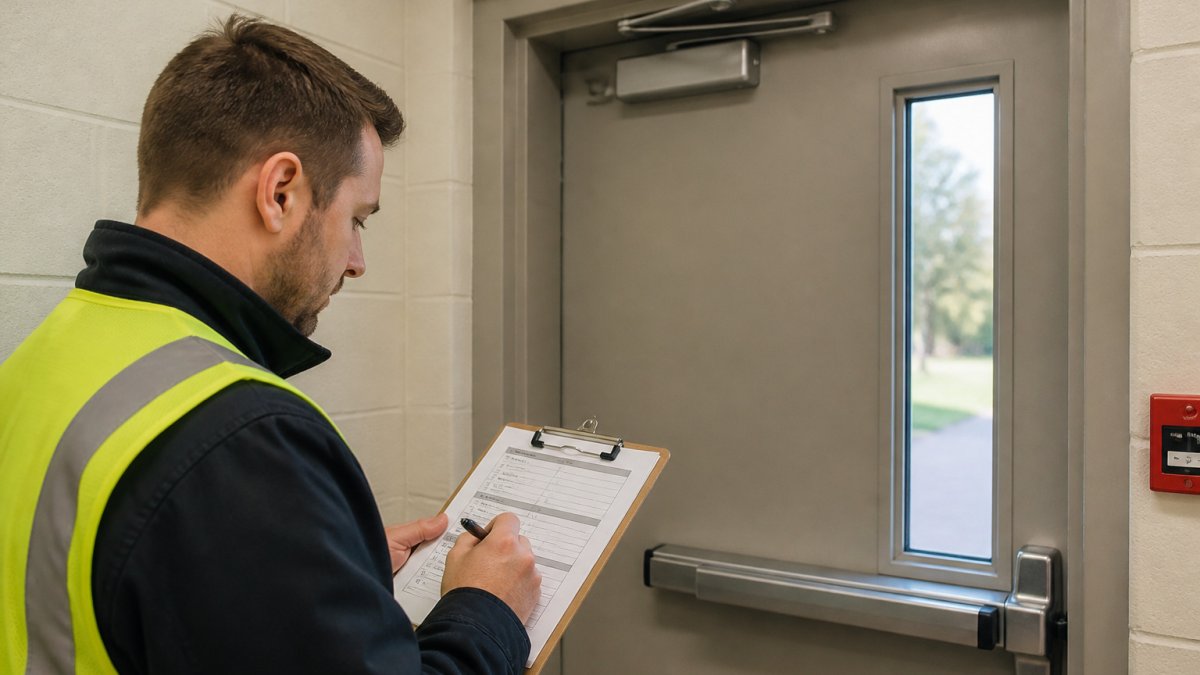
A fire exit door must open easily from the inside without a key. Anyone should be able to push the bar or turn the handle to leave, with no knowledge of a code or key needed.
Look for:
- Push bars or panic hardware that release with a single action
- No key, card or code needed to leave
- Doors that open in the direction of escape where required
Keyless entry systems can suit offices that need security, but the exit side must always open freely. Compare lock grades and security options Compare keyless entry options for offices If an access control system holds a door shut, check that it releases automatically on a fire alarm and that the way out stays open.
Fire Door Ratings, Self-Closers and Seals
Fire doors are rated by how long they resist fire and smoke. Common ratings include FD30 (30 minutes) and FD60 (60 minutes). The rating a door needs depends on its position in the building, so check the fire risk assessment rather than guessing.
A fire door only works if it is kept closed. Check these parts:
- Self-closing device: the door must shut fully on its own
- Intumescent seals: these swell in heat to block fire and smoke
- Smoke seals: these limit smoke passing around the edges
- Door frame and leaf: no gaps, cracks or damage
Never prop a fire door open with a wedge. A fire door held open loses its protection.
Fire Exit Signage Requirements
Exit signs must show people where to go, even in smoke or low light. Signs should be clear, correctly placed and lit where required.
Check that:
- Exit signs are visible from the main parts of the route
- Signs point clearly towards the nearest exit
- Lighting works and any battery backup is tested
- Signs are not covered by furniture, plants or posters
The Health and Safety (Safety Signs and Signals) Regulations 1996 set the requirements for safety signs in workplaces. Health and Safety (Safety Signs and Signals) Regulations guidance
Fire Door Inspection Checklist and Inspection Frequency
A regular check finds problems before they cause harm, but the frequency and depth of inspection should be set by your fire risk assessment, not by habit. Read a broader guide to commercial security systems Inspection can be organised in three tiers: routine user checks, formal periodic inspections, and annual specialist reviews.
Routine user checks
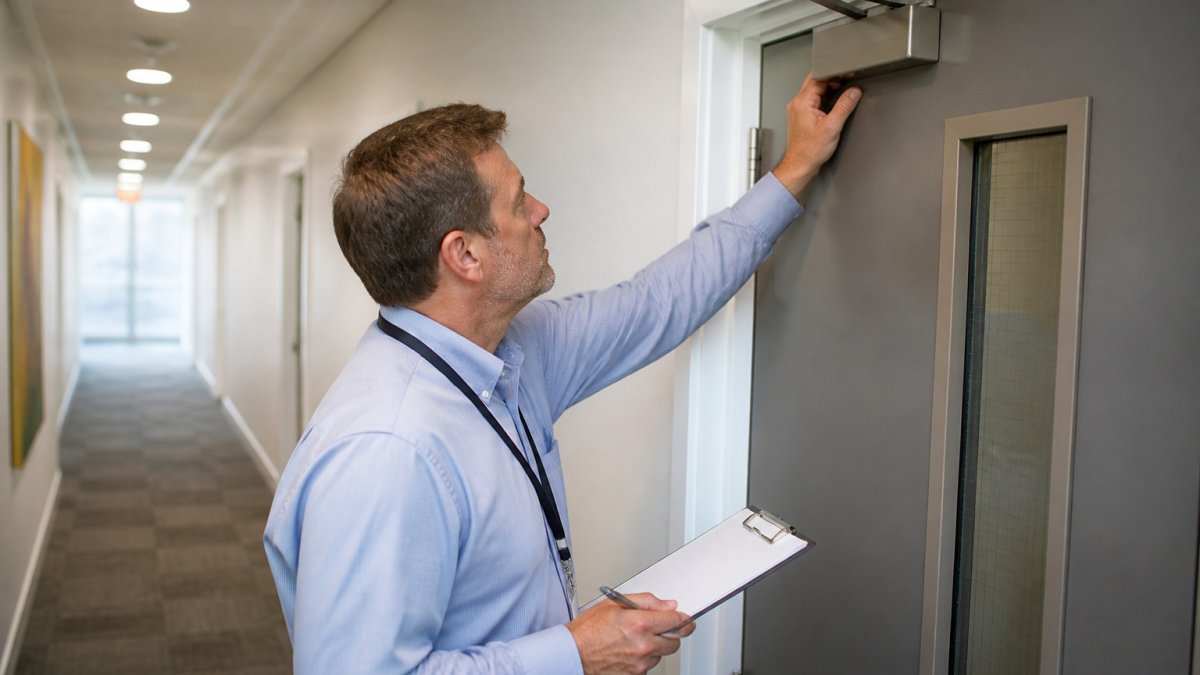
These are quick visual checks carried out by office staff or facilities teams, typically weekly or monthly. They are not a substitute for a formal inspection but catch the most common failures early:
- Door opens easily from the inside without a key, card or code
- Self-closer shuts the door fully from any open angle
- No wedges, chairs or other propping in place
- No obstructions in the immediate exit route
- Fire door sign is in place and readable
- No obvious damage to the door leaf, frame or seals
- Exit signage is lit and visible
Record each check with the date, the person who did it and any defects found. A simple log book or spreadsheet is enough, provided it is kept up to date and available for inspection.
Call us 24/7: +44 77321 89721 →
Formal periodic inspections
These are more detailed checks, usually every three to six months depending on footfall and risk. They should cover:
- Door closes and latches fully from any angle
- Self-closing device operates smoothly and is not disconnected
- Intumescent and smoke seals are intact, undamaged and correctly fitted
- Gaps between door and frame are within the limits set for the door's fire rating
- Door frame and leaf are free from cracks, warping or damage
- Hinges are secure and not worn
- Panic or emergency-release hardware operates with a single action
- Access control releases automatically on fire alarm and the exit side remains free
- Exit route ahead is clear and unobstructed
- Exit signage is lit and visible, with battery backup tested where fitted
Record the results, the date, the inspector and any corrective actions taken. Keep these records in your fire safety file.
Annual specialist review
A competent fire door specialist should review all fire doors at least annually, and more often in high-risk or high-use buildings. This review should include a closer examination of the door assembly, hardware and seals, and should confirm that the door still meets its intended fire rating.
Setting your frequency
Your fire risk assessment should set the frequency for your building. Factors to consider include:
- The number of people using the door and the route
- Whether the door is in a high-risk area (e.g. near kitchens, storage or plant rooms)
- The age and condition of the door and hardware
- Any history of defects or near-misses
- Whether the door is also used for general circulation
Fire door maintenance guidance
The article sets out three tiers of inspection, each with a different frequency and depth.
| Inspection tier | Typical frequency | What it covers |
|---|---|---|
| Routine user checks | Weekly or monthly | Quick visual checks by staff or facilities |
| Formal periodic inspections | Every three to six months | Detailed checks of seals, closers, gaps and hardware |
| Annual specialist review | At least annually | Closer examination of door assembly and fire rating |
What to Do When an Emergency Exit Door Fails Inspection
If a door fails, act quickly. A failed exit door can put people at risk, so do not leave it as it is while you wait for a repair. The following defect triage process helps you prioritise actions and keep the building safe in the meantime.
Step 1: Triage the defect
Assess the defect against these categories:
- Critical: The door cannot be opened from the inside without a key, or the exit route is blocked. This is an immediate risk to life. Stop using the door if possible, or provide an immediate alternative route, and arrange urgent repair.
- Major: The door opens but the self-closer fails, seals are damaged, or gaps are excessive. The door may not contain fire and smoke effectively. Restrict use if the door is a fire door, and arrange repair within a short timescale (e.g. 24-48 hours).
- Minor: Signage is missing or damaged, or there is minor wear that does not affect operation or fire performance. Arrange repair within a reasonable period (e.g. 7-14 days) and monitor.
Step 2: Apply temporary risk controls
While waiting for repair, put temporary controls in place:
- Remove any obstruction or propping straight away
- If the door cannot be made safe, restrict access to it and ensure an alternative escape route is available and clearly signed
- Increase the frequency of checks on the affected door
- Brief staff on the temporary arrangement
- Record the temporary controls and the reason for them
Step 3: Arrange repair by a competent person
Use a competent person with experience of fire doors and exit hardware. Keep a record of who carried out the repair and what was done.
Step 4: Re-check and close out
After the repair, re-check the door against the original defect and the full checklist. Only close out the defect when you are satisfied the door is safe and compliant. Record the re-check date and the person who signed it off.
Step 5: Record and review
Keep a record of the defect, the action taken, the date it was fixed and any temporary controls used. Review defects periodically to identify recurring problems, which may indicate a need for replacement rather than repeated repair.
Fire safety risk assessment guidance
Booking a Compliance Check and Hardware Upgrade With WS Locksmiths
Some faults need more than a quick adjustment. WS Locksmiths works with homes and businesses across Crawley, Horsham, Horley and Redhill, and can help with locks, repairs and security upgrades. Check whether you must pay on the spot before work begins Call us 24/7 on +44 77321 89721 to discuss your premises and book a visit. For current prices, please contact WS Locksmiths directly for a quote.
Frequently Asked Questions
What are the requirements for emergency exit doors in an office?
Emergency exit doors in UK offices must open easily and immediately from the inside without a key, tool or special knowledge. Under the Regulatory Reform (Fire Safety) Order 2005, the responsible person must ensure escape routes and exits are available, adequate and kept clear. Final exit doors should open in the direction of escape where the number of occupants requires it, and any fire doors must carry appropriate ratings such as FD30 or FD60 and be maintained in working order. A written fire risk assessment is the usual starting point for confirming what your premises need.
Do office fire exit doors need to open outwards?
Doors on an escape route should generally open in the direction of escape, particularly where a room holds a larger number of people. Opening outwards reduces the risk of crowds pushing against a door that opens inwards. The exact requirement depends on occupancy and layout, so your fire risk assessment should confirm the correct swing for each door. Where a door swings the wrong way, the fix often involves a change of hinges or a reassessment of the route.
Can an emergency exit door be locked from the inside?
No. An exit door must be operable from the inside at all times without a key, so occupants can leave without delay. Panic hardware or a simple lever or push bar is typically used, and any keyless opening device should be checked to ensure it releases reliably. Where security needs call for controlled access from the outside, access control can be fitted provided the inside release remains fully functional.
How often should office fire exit doors be inspected?
Fire doors are generally inspected at least every six months, with a more detailed check following any damage or change in use. Inspections should cover the door leaf, frame, intumescent and smoke seals, gaps, hinges, self-closing devices and locking hardware. Record each inspection, the name of the person carrying it out, and any defects found with their remedial actions. The responsible person should set the frequency based on the fire risk assessment and document the reasoning.