 ultimate-guide
Cost of Emergency Lock Repairs: What to Expect
Table of Contents
- What Determines the Cost of Emergency Lock Repairs
- Understanding Emergency Locksmith Call-Out Fees
- How Long Does an Emergency Lock Repair Take and Why It Matters
- Locksmith Hourly Rates vs Fixed Price: Which Offers Better Value
- Repair vs Replacement: Cost Comparison for Emergency Situations
- How to Avoid Hidden Fees and Get a Fair Quote
- Frequently Asked Questions
Last Updated: September 25, 2026
What Determines the Cost of Emergency Lock Repairs
The cost of emergency lock repairs varies considerably depending on several interconnected factors. Understanding what drives pricing helps you anticipate expenses and avoid surprises when you're in a stressful situation.
The primary cost drivers include the time of day you need service, the complexity of your lock mechanism, whether repair or replacement is necessary, and your location. A straightforward lock adjustment at midday costs significantly less than diagnosing and fixing a damaged mortice lock at 3 AM on a Sunday. The locksmith's travel time, the specific tools required, and the parts needed all factor into the final bill.
Emergency situations often involve multiple variables that compound costs. A broken key stuck inside a lock requires different expertise than a snapped bolt. A commercial property with high-security locks demands more specialised knowledge than a standard domestic door lock. Your property's accessibility also matters, ground-floor entry points are quicker to reach than upper-floor windows or recessed doors.
Understanding Emergency Locksmith Call-Out Fees
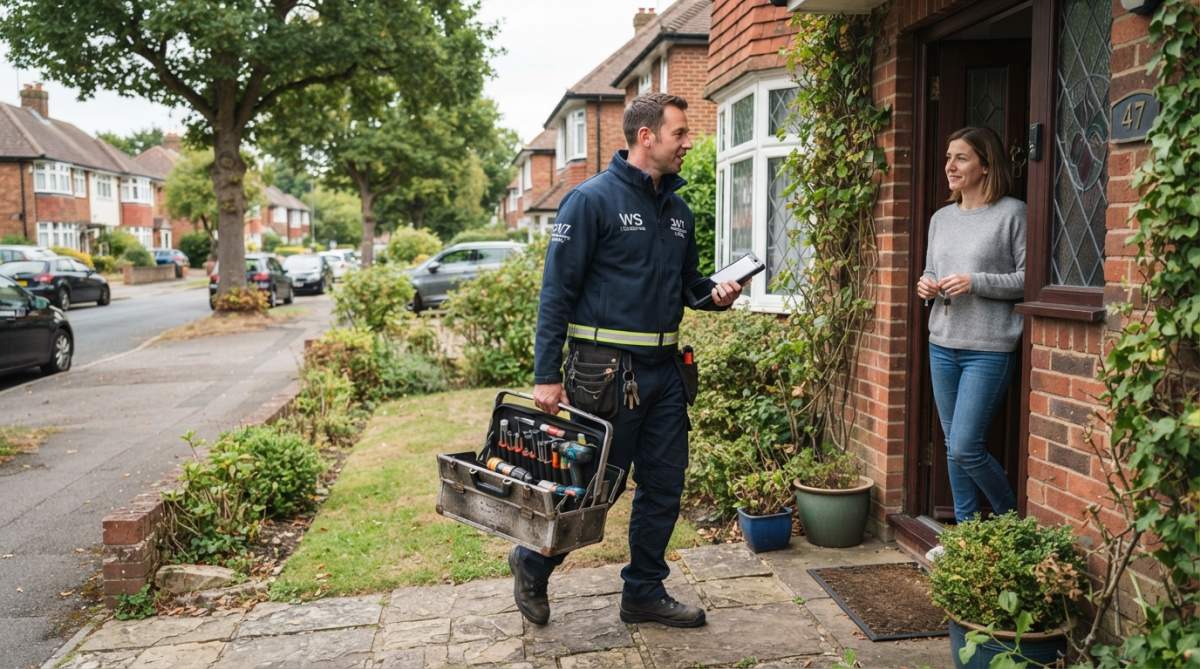
An emergency locksmith call-out fee is a fixed charge for arriving at your property outside standard business hours. This fee covers the locksmith's travel, fuel, and availability guarantee, they're committing to respond to your emergency rather than handling routine daytime appointments.
Call-out fees typically apply to work requested between 6 PM and 8 AM on weekdays, and anytime on weekends and bank holidays. The exact threshold varies by provider. Some locksmiths charge the same rate for all after-hours work; others scale fees based on how late the call is. A midnight emergency costs more than a 6 PM lockout, reflecting the disruption to the locksmith's schedule.
What many people don't realise is that call-out fees often apply even if the locksmith can't complete the work immediately. If your lock requires a part that isn't in stock, or if the damage is more extensive than initially assessed, you've already paid the call-out charge. This is why getting a clear quote over the phone before the locksmith arrives matters, you'll know whether the call-out fee is refundable against the final invoice or a separate charge.
Some providers bundle the call-out fee into their hourly rate for emergency work, meaning you pay a higher hourly rate that includes the emergency surcharge. Others keep them separate. Neither approach is inherently unfair; the key is understanding which model applies to your quote.
How Long Does an Emergency Lock Repair Take and Why It Matters
The duration of an emergency lock repair directly affects labour costs. A simple lock cylinder replacement might take 15 to 30 minutes. A jammed mortice lock that requires careful extraction and reassembly could take 45 minutes to over an hour. Diagnosing the problem, which often happens on-site, adds time before actual repair work begins.
Why does duration matter financially? Most locksmiths charge either a fixed rate for common jobs or an hourly rate for complex work. If you're on an hourly rate, a 90-minute job costs roughly 50% more than a 60-minute job. If you're on a fixed price for the type of repair, duration is less relevant to your bill, but it still affects how long you're without secure access.
Certain factors extend repair time unexpectedly. Corroded locks, non-standard mechanisms, or locks installed in difficult-to-reach locations all require more time. A lock on a reinforced commercial door takes longer to access than one on a standard domestic frame. If the locksmith discovers that repair isn't viable and replacement is necessary, the job duration increases significantly.
Time of day also influences how quickly work progresses. A daytime repair with good natural light moves faster than a nighttime repair under torchlight. The locksmith's familiarity with your lock type matters too, a common domestic lock is quicker to address than a specialised high-security mechanism.
Locksmith Hourly Rates vs Fixed Price: Which Offers Better Value
Locksmiths typically use one of two pricing models: hourly rates or fixed prices for specific jobs. Each has distinct advantages depending on your situation.
Fixed prices work best when the problem is straightforward and commonly encountered. A standard lock cylinder replacement, a broken key removal from a standard lock, or a simple adjustment to a domestic lock all suit fixed pricing. You know the cost upfront, there's no surprise bill, and the locksmith has a financial incentive to work efficiently. Fixed prices also simplify comparison shopping, you can call three locksmiths and compare their quoted prices for the same job directly.
Hourly rates apply when the problem is complex or the solution uncertain. If the locksmith can't diagnose the issue without examining the lock in detail, an hourly rate protects them from underpricing difficult work. It also protects you from overpaying if the job turns out simpler than expected. However, hourly rates introduce uncertainty, you won't know the final cost until the work is complete.
The real value question isn't which model is cheaper in absolute terms, but which matches your situation. A simple job with a fixed price gives you certainty and usually represents good value. A complex job on an hourly rate is fairer than a fixed price that might underestimate the actual difficulty.
Call us 24/7: +44 77321 89721 →
Repair vs Replacement: Cost Comparison for Emergency Situations
When your lock fails, you face a choice: repair it or replace it. Each option carries different costs and implications.
Repair is almost always cheaper upfront. A locksmith might adjust a misaligned bolt, replace a broken internal component, or remove a stuck key, all repairs that cost less than a full lock replacement. If the lock is functioning but damaged cosmetically or mechanically in a minor way, repair makes financial sense.
Replacement becomes necessary when the lock is structurally compromised, the mechanism is damaged beyond repair, or the lock has been forced open. A lock that's been attacked in a break-in, a mortice lock with a snapped bolt, or a cylinder that's been drilled out all require replacement rather than repair. Replacement costs more initially but provides a fully functional lock with no lingering reliability concerns.
The decision often hinges on the lock's age and security level. An older standard lock might be worth replacing even if repair is technically possible, you gain a modern, more secure lock. A newer high-security lock is worth repairing if the damage is minor, because replacement costs significantly more.
Emergency situations complicate this calculation. If you're locked out at 2 AM and need immediate access, repair might be the fastest option to restore entry. However, if the repair is temporary and the lock will fail again soon, you're paying twice, once for emergency repair, again for replacement during business hours. Sometimes it's more cost-effective to pay for emergency replacement upfront rather than emergency repair followed by daytime replacement.
How to Avoid Hidden Fees and Get a Fair Quote
The difference between a transparent quote and a bill full of surprises often comes down to asking the right questions before the locksmith begins work.
First, confirm whether the quoted price includes the call-out fee. Some quotes bundle it; others add it later. Ask explicitly: "Is the call-out fee included in this quote, or will it be added to the final bill?" Second, clarify what the quote covers. Does it include the lock cylinder, labour, and travel? Are parts extra? A clear breakdown prevents arguments when the invoice arrives.
Third, ask about potential additional charges. If the lock is more damaged than initially suspected, will the locksmith call you before proceeding with extra work? Will they attempt repair first, or move straight to replacement if repair seems unlikely? Establish these boundaries before work starts.
Fourth, confirm the locksmith's hourly rate if the job might be charged hourly. Ask what constitutes an hour of work, is a 30-minute job billed as half an hour, or rounded up to a full hour? Some locksmiths round up to the nearest 15 minutes; others bill in full-hour increments. Knowing this affects your final cost.
Finally, ask whether the quote is fixed or an estimate. A fixed quote means that's your final cost (barring unforeseen complications you've agreed to beforehand).
Frequently Asked Questions
Do you have to pay a locksmith straight away?
Payment terms depend on the locksmith and the job. Most reputable locksmiths will quote you before starting work and explain their pricing structure upfront. Some accept payment on completion, whilst others may require a deposit for emergency call-outs. Always ask about payment methods and timing before work begins to avoid surprises. Fully trained and vetted locksmiths will be transparent about costs before they touch your lock.
What factors influence the cost of an emergency lock repair?
Several factors affect emergency lock repair costs: the type of lock and damage, time of call (nights, weekends, and bank holidays typically cost more), how quickly you need access, whether the lock needs repair or replacement, and your location. Complex locks or significant damage requiring replacement will cost more than simple adjustments. Call-out fees also vary depending on the locksmith's response time guarantee and service area.
Is it cheaper to repair a lock or replace it entirely?
Repair is usually cheaper than replacement if the damage is minor, such as a jammed mechanism or broken key. However, if the lock is damaged beyond safe repair, worn out, or compromised after a break-in, replacement becomes the better option. A qualified locksmith can assess the damage and advise whether repair is viable. For security upgrades, replacement with a high-security lock may be worthwhile even if repair is possible.
Are there extra charges for out-of-hours emergency locksmith services?
Yes, most locksmiths charge premium rates for out-of-hours call-outs, including nights, weekends, and bank holidays. These surcharges reflect the cost of providing 24/7 availability and rapid response. The exact surcharge varies by locksmith, but you should expect higher costs outside standard business hours. Ask for a clear breakdown of any out-of-hours fees before booking to understand the total cost.